
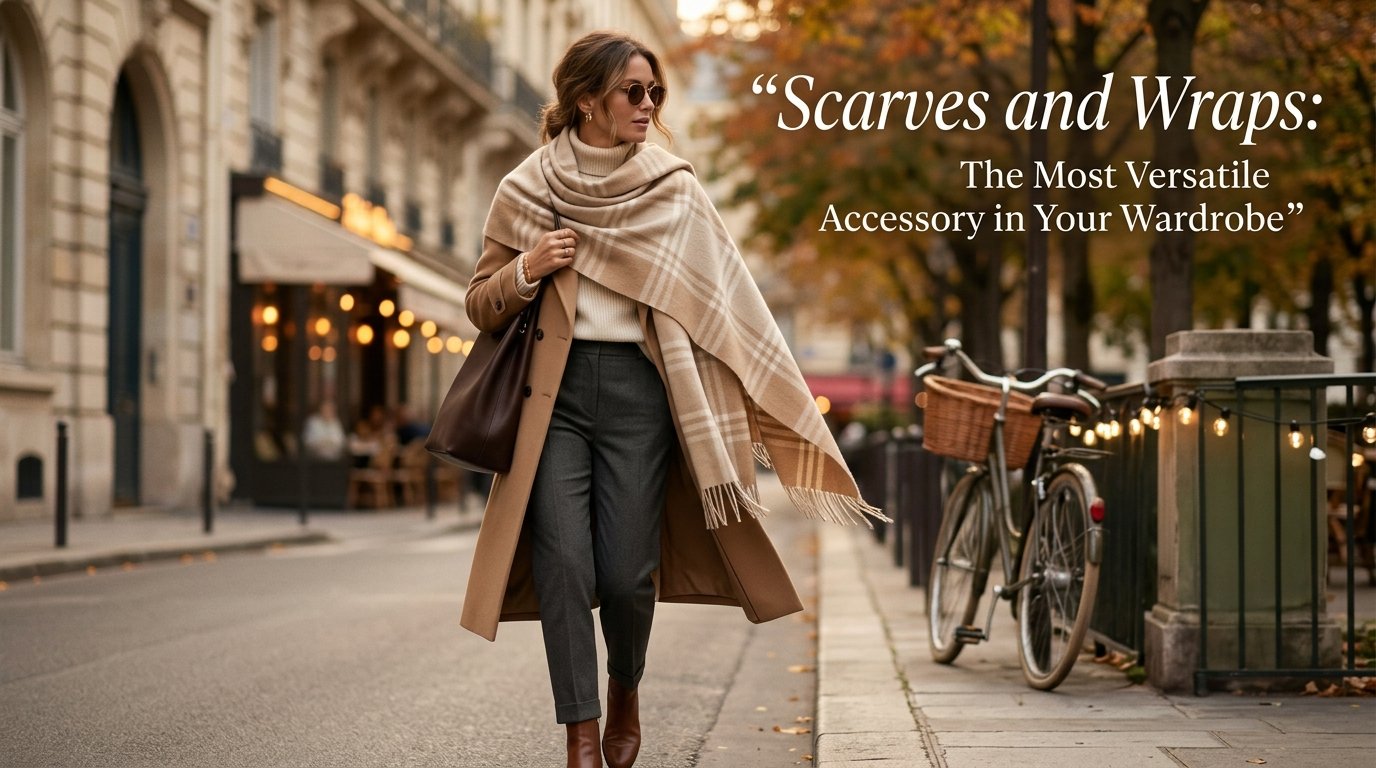
Why the Scarf Is the Most Versatile Accessory You Own
Ask any professional stylist or costume designer which single accessory offers the greatest versatility relative to its size, and most will say the scarf. It can be worn around the neck in dozens of configurations, tied in the hair, used as a belt, draped over the shoulders as a light wrap, fastened around a bag handle, or worn as a bandeau top. For its dimensions and price, a quality scarf does more than almost any other accessory in existence.
Film has always understood the scarf’s power. Brigitte Bardot’s casual head-tied silk square. Audrey Hepburn’s graceful neck wrap. The countless heroines of British and European cinema who have used a scarf to communicate effortless chic without apparent effort. The scarf is a shorthand for a particular kind of casual sophistication that never dates.
Types of Scarves and What Each Does Best
The silk square — approximately 90cm x 90cm — is the most iconic format. Hermès popularised it, but quality silk squares are available across a much broader price range. Worn tied loosely around the neck with ends tucked into a collar, folded into a triangle and draped around the shoulders, or tied to the handle of a bag for a pop of colour and pattern, the silk square has an almost unlimited range of applications.
The long oblong scarf — typically 150-200cm long — is the most practical format for colder British weather. In cashmere, lambswool, or a quality wool blend, it wraps generously around the neck with room for multiple loops, and provides meaningful warmth in winter without adding bulk. Draped loosely under a coat collar or worn as a more casual neck wrap in milder temperatures, the long scarf is an autumn-winter essential.
Lightweight cotton and linen scarves in looser weaves are the summer alternative — providing some sun protection and a gentle layer of warmth in air-conditioned environments without adding heat. They work beautifully tied in the hair in a retro headscarf style, worn at the beach over a swimsuit, or draped loosely around the neck for casual elegance.
How to Tie a Scarf: The Essential Knots
The classic loop: fold a long scarf in half, place around the neck, and thread the loose ends through the loop. Adjust tightness to preference. This is the warmest and most secure configuration for cold weather. The loose drape: simply place around the neck with both ends hanging at the front. For longer scarves, let one end hang lower than the other for a more deliberate, asymmetric look. The French knot: wrap once around the neck and tie loosely at the front with both ends, leaving the knot slightly to one side for a casual, Parisian feel.
Caring for Scarves
Silk scarves require gentle hand washing in cool water with a specialist silk detergent, or dry cleaning. Never wring — roll in a clean towel to remove excess water and allow to dry flat. Cashmere and fine wool scarves should be hand washed or dry cleaned and stored folded (not hung) to prevent stretching. Cotton and linen scarves are generally machine washable on a gentle cycle.
Frequently Asked Questions
Q: Is a Hermès scarf worth the investment?
A: The quality is genuinely exceptional — the hand-rolled edges and screen-printed designs are extraordinary at close inspection. As an investment piece that you will wear for decades, it represents fair value for money at its price point. But excellent alternatives exist at significantly lower prices.
Q: What colours of scarf are most versatile?
A: Navy, cream, camel, and classic patterns like tartan or paisley in neutral tones work with the broadest range of outfits. A bold colour in a pattern you love will work if your wardrobe has neutrals to balance it.
Q: Can men wear silk scarves?
A: Absolutely. Silk square scarves have a strong heritage in men’s fashion, particularly worn in the breast pocket of a jacket or loosely tied around the neck. The styling simply requires slightly different configurations than those typically seen in women’s fashion.